A great deal of what listeners describe as the “sound” of these songs is a single chord, placed with care. It has a name, and the name is the band’s own. I will not speculate on why it is called what it is called. I will only say what it is.
1. Definition
The mu major is a major triad with an added second, in which the second is placed immediately below the third, so that the two notes sound a whole step apart. In C, bottom to top: C, D, E, G.
That is the whole of it, but each part of the definition is load-bearing, and it is worth setting the conditions out separately, because a chord that fails any one of them is a different chord.
- The third is major. The chord is built on a major triad.
- The second is present. It is added to the triad, not substituted for any part of it.
- The second is adjacent to the third. The two notes are voiced a whole step apart, in the same octave, with the second below. This is the rub, and the rub is the point.
- There is no seventh. The chord is a triad with one addition, not a seventh chord with extensions.
Please note that the third condition is a condition of voicing, not of content. Two chords can contain exactly the same pitch classes and only one of them be a mu. This is the source of most of the confusion on the subject, and I will return to it more than once.
2. What it is not
The mu major is frequently confused with four neighbors. For clarity:
The added ninth. C(add9) contains the same four pitch classes as C mu: C, E, G and D. The difference is that the D is placed above the octave, a ninth from the root. The whole step becomes a major ninth, which is an open, consonant-sounding interval, and the rub disappears. Chord symbols do not distinguish between the two. The ear does, immediately. A chart that reads “Cadd9” may be asking for either, and the player must decide.
The suspended second. Csus2 is C, D, G. The third has been removed, not supplemented. Nothing rubs, because there is no E for the D to rub against. The result is open and ambiguous; it is neither major nor minor. The mu is unambiguously major. Its second is an addition to a complete chord.
The major ninth. Cmaj9 adds a B. A major seventh changes the gravity of a chord considerably; it leans. The mu does not lean. It is, and I use the word precisely, a triad.
The six-nine. C6/9 adds both the D and an A. With the A present, the chord contains the complete major pentatonic collection, C, D, E, G, A, and becomes softer and more diffuse. It is a fine chord. It is not this one.
I should also address the minor form. If the triad is minor (C, D, E♭, G), the added second lies a half step below the minor third, not a whole step. The resulting interval is a minor second, which is considerably harsher, and the character of the chord changes entirely. I have seen this called a “mu minor.” I do not use the expression, and I do not think the chord is a relative of the one under discussion.
3. Why it asks for nothing
Most chords that contain a dissonance want to resolve it. The suspended fourth is the textbook case: in Csus4 (C, F, G), the F is heard as a displaced E, and the ear waits for it to fall. Classical harmony treats the suspension as a debt to be paid on the next beat.
The mu contains its own resolution. The second, D, would naturally resolve upward to E, and E is already sounding, directly above it. The chord therefore presents a dissonance and its resolution simultaneously, and declines to choose. This is why it can be held for a full bar, or four, or ended on, without any sense that something has been left unpaid.
A second way to describe the same property: the four notes of the mu (1, 2, 3 and 5 of the scale) are four of the five notes of the major pentatonic scale. A pentatonic collection contains no half steps and no tritone, which are the two intervals most responsible for harmonic tension of the leading-tone kind. The mu therefore has color, from the whole step, but no pull. It is bright in the way that a well-lit room is bright. Nothing in it is going anywhere.
It should be said that this is also why the chord is easily overused. A chord that asks for nothing can be placed anywhere. In my own arrangements it is never placed as decoration. Each occurrence is recorded in the arrangement log, and each has a reason in the column provided.
4. The limit
Close intervals lose definition in the low register. Two notes a whole step apart, played near the bottom of the piano, do not sound like two notes; they sound like one unclear note with a disturbance in it. Orchestrators and arrangers work with an approximate floor for each interval, below which it should not be voiced. For the major second, the floor usually given is around the E♭ below middle C, E♭3. I have tested this on my own instrument and my own monitors, at a moderate velocity,1 and I would place it a little higher, at F3.
In practice this means the mu belongs in the middle of the keyboard, in the right hand, with the left hand providing the root and, at most, a fifth or a tenth. The bass pedals, which sound an octave below the left hand, take the root when the left hand is required elsewhere.
Readers who have seen the transposition disclosure in the printed program will ask how the limit is reconciled with performing every selection a whole step down. It is reconciled by revoicing. Every mu in the program was checked against the limit after transposition. Eleven were moved up an octave. None were moved down.
5. Over another bass
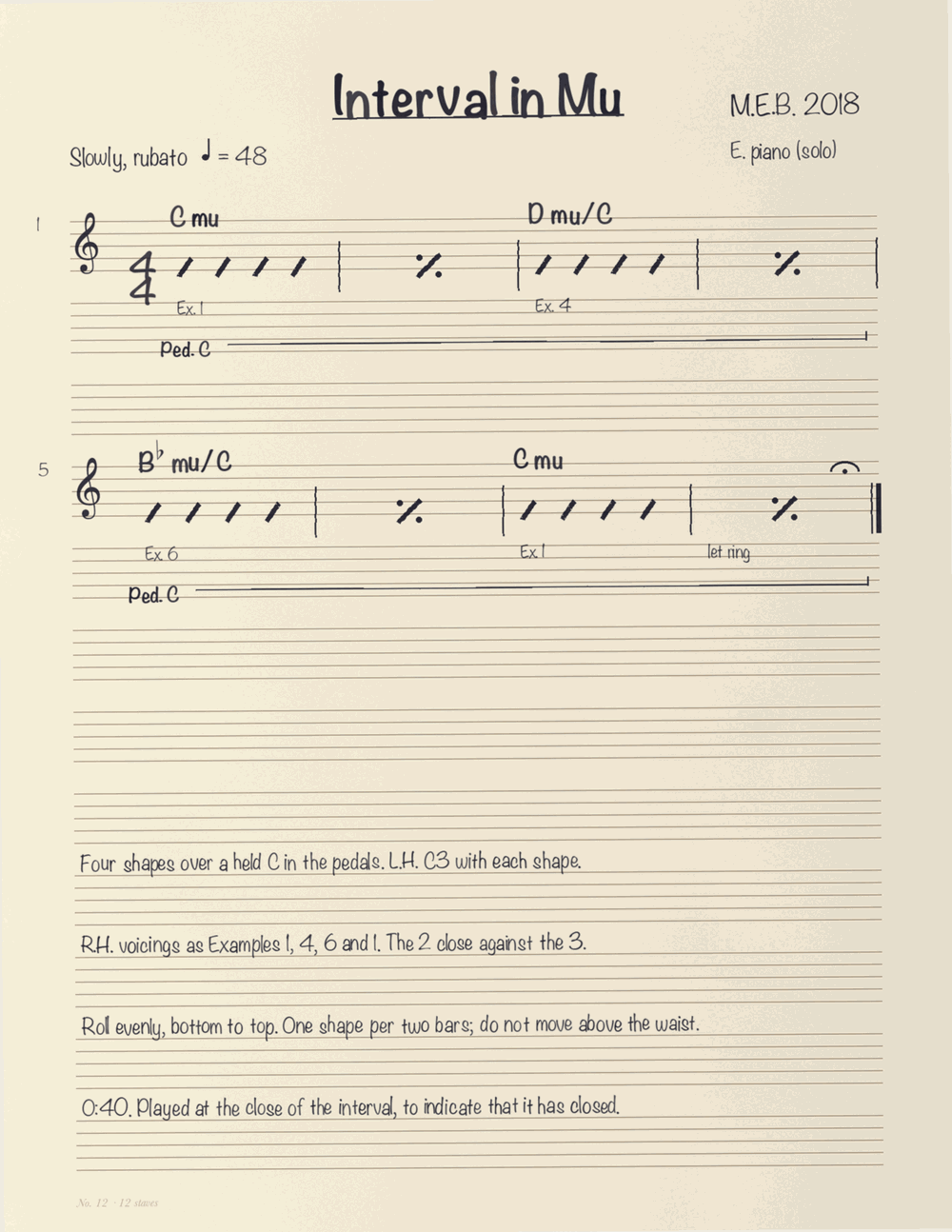
The mu major is most interesting when it is not over its own root. Placed over a different bass note, the same four-note shape becomes the upper structure of a larger chord, and the whole step moves to a new position in that chord. Three placements over C are worth knowing. They are given here as shapes, not as passages from any song.
Set out as a rule: a mu a whole step above the bass gives a major chord with a raised eleventh; a mu a minor third above the bass gives a minor eleventh; a mu a whole step below the bass gives a suspended dominant. The shape under the hand does not change. Only the bass changes, and with it the meaning of every note above it.
This is the practical value of the chord to an arranger working alone. The right hand can hold a single, well-voiced shape while the pedals move beneath it, and the harmony changes completely without any movement above the waist. I have found this indispensable. I would add, for clarity, that it is a technique of voicing, available to anyone at a piano, and that I make no claim to it.
6. Motion
When mu chords move in parallel, each shape transposed intact to a new root, the rub travels with them. The effect is less a progression than a color moving across a surface. Parallel motion of this kind (sometimes called planing) is best in short spans; over more than three or four chords it begins to sound like a device, which it is.
My own interval piece, Interval in Mu, is forty seconds long and consists of four shapes over a held C in the pedals: C mu, D mu, B♭ mu and C mu again. It is Examples 1, 4, 6 and 1, in that order. It is played at the close of the interval to indicate that the interval has closed. It is included here so that the examples above can be heard in succession.
7. Fingering and margins
In the right hand, in close position: thumb on C, index finger on D, middle finger on E, fifth finger on G. The index and middle fingers are therefore responsible for the whole step, and they must strike together.
I use the word margins for how cleanly a chord begins and ends. A mu with poor margins, one in which the D arrives a fraction before or after the E, is not heard as a chord at all. It is heard as a grace note, an ornament on the third, and the rub becomes a gesture. In my experience the two notes must arrive within approximately ten milliseconds of each other to be heard as simultaneous. I practiced this with a metronome, and later with a recording and a waveform display, for some months in 2010.
The release matters equally. A mu from which the D lifts early resolves itself audibly into a plain triad, which is a small event and should not occur unless it is intended. Where it is intended, it is marked in the arrangement.
8. Why it matters to the program
The songs of Walter Becker and Donald Fagen are often described as sophisticated. I would prefer the word exact. The mu major is exact in a particular way: it is bright, but its brightness contains a small, deliberate disturbance, placed where the ear cannot miss it and cannot quite object to it. The chord is agreeable, and something in it is slightly wrong on purpose. I have come to think that this is the harmonic form of the songs’ other sensibility, and that the two were never separate.
I first heard the chord in 1978, without a name for it, and have spent some time since then finding out what it was. That is the history of this program, in one sentence. The rest is voicing.
- MIDI velocity of approximately 64, through the reference monitors in the rehearsal room at a listening distance of 1.1 m. Results on other instruments will differ, and I would be interested to receive them. ↩